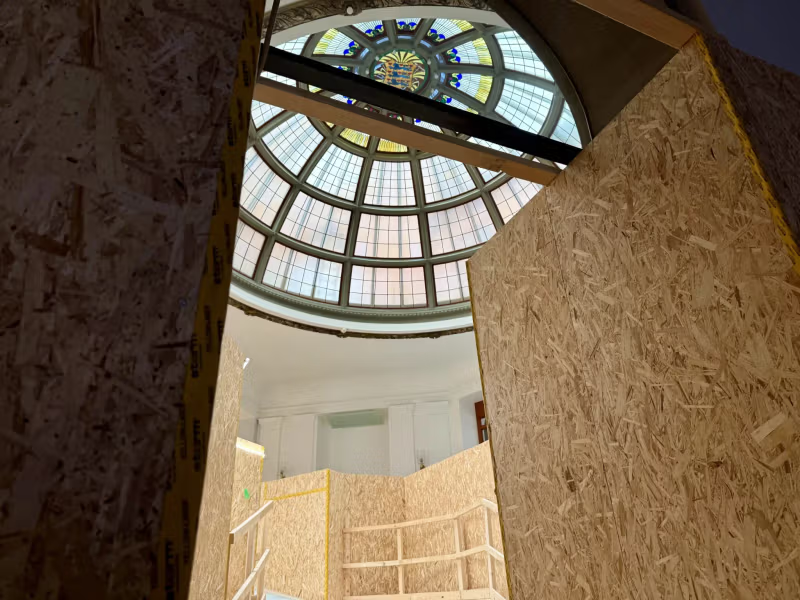
A lot has happened behind the construction site hoarding over the summer. Below is an update covering a nearly completed soft strip, remarkable historical finds, and a decoration of the hoarding around the site with historical highlights.
Unforeseen conditions push the timeline slightly
Inside the buildings, the soft strip – the careful removal of non-load-bearing elements such as suspended ceilings, floors, and installations – is well underway. Unforeseen conditions over the summer have caused a small change to the timeline, and the soft strip is now expected to be completed in October 2025.
The last 150 years as a banking quarter in particular can be seen in the interior strip, explains Project Director Glenn Jaes:
"I'd estimate we've found thousands of kilometres of cable – which we need to sort through and trace to figure out where it all leads. It's a huge puzzle, and it takes time to piece together."
He continues: "It's completely normal to see a change in the timeline once the strip-out begins. Fittings and fixtures don't always look the way you'd imagined, so we're also prepared for surprises to come up along the way."
Like a treasure hunt: Hidden marble staircase and ceiling painting
The buildings, which are more than 200 years old, have been altered and added to over time, meaning the team has come across everything from older installations to hidden architectural gems.
"We're removing almost all the installations to get back to the raw structures. The exception is the heating systems, which we're keeping in operation so the buildings can stay warm throughout the process – allowing us to preserve sensitive existing areas," Glenn Jaes explains, while also emphasising the respect for the listed properties:
"The entire transformation is being carried out with great respect for the fact that we're working with listed buildings that are part of our shared cultural heritage. We're proceeding carefully, with a deep commitment to the high architectural quality and the historical details."
Historical finds brought back to life
And the start of the soft strip has been anything but dull.
In the basement beneath Peschier's Mansion (Holmens Kanal 12), an old marble staircase has been uncovered, hidden behind a tangle of installations. The staircase appears on the original drawings and has long been planned for reinstatement, but it turned out to be surprisingly well-preserved. Only minor repairs and a new handrail are needed. When the doors open to Laksegade Kvarteret, the restored staircase will serve as the main entrance to a new canteen area.
On the first floor of Peschier's Mansion (Holmens Kanal 14), another exciting discovery has been made. After removing a suspended plaster ceiling, an almost intact ceiling painting was revealed in the old banking hall, originally from when the mansion was built. It will now be restored to its original splendour so it can become part of the interior design in the future.
"It's pure treasure hunting. We have the original drawings of the buildings to work from, and we have to proceed carefully when removing the more recent fittings. It's an important reminder that we're working with buildings that have history and soul, and that we need to look after them," says Glenn Jaes.
Everything is being documented so the architects and engineers have the foundation they need for the next phases of the design-build contract.
Laksegade Kvarteret's history brought to life with the help of the Museum of Copenhagen
Over the summer, the hoarding around the construction site has been decorated with stories from Laksegade Kvarteret's more than 400 years of history.
The Museum of Copenhagen has helped select and fact-check which stories to feature on the hoarding – a task curator Trine Halle was happy to take on:
"It's important to tell the city's stories, because we need to know the city we live in. It may sound banal, but when we know the stories about what surrounds us – buildings and streetscapes – we know our history. And when we know our history, we become better at looking after it," she says, and continues:
"It's wonderful that something as practical as a construction site hoarding can be used to share a little piece of Copenhagen's history, and hopefully give passers-by a reason to stop and read along."
Many chapters in the quarter's history
Laksegade Kvarteret's history has many layers, and the area around Laksegade has over the years been the setting for major milestones in history. The area was once home to many of the navy's people, with taverns and lively goings-on to match. Later, Laksegade became a quieter quarter due to the many banks that settled in the area.
One of the stories featured on the hoarding is that of Skipperboderne. The area actually predates the construction of Nyboder:
"This was once the site of Skipperboderne – a cluster of houses where the naval officers lived when they weren't at sea. The houses were small and modest, suited to owners who were often away from home for long stretches. The king needed more housing for the many officers in the fleet and their families, and so Christian IV had Nyboder built between 1631 and 1641. This meant that the officers gradually left the quarter and moved into Nyboder instead. The Skipperboderne in Størrestræde were lost in the Copenhagen fire of 1795, and Størrestræde became part of Holmens Kanal in 1877," Trine Halle explains, and concludes:
"The area is now being given new life again – which is what a big city is made of: it keeps developing."
The Museum of Copenhagen tells 1,000 years of Copenhagen stories. The museum is open every day of the week from 10:00 to 17:00, with extended hours on Thursdays until 20:00.